Any modern business knows that they need to track assets and inventory to increase efficiency, reduce costs, and respond quickly in case of a recall. Vehicle manufacturers are no different. Whether they produce cars, forklifts, motorcycles, or even golf carts, they need complete visibility into their operations.
The challenges that vehicle manufacturers face are twofold:
- The must quickly and efficiently move vehicles coming out of production to customers and dealer networks.
- They must track developmental vehicles through the research and development process.
The solution? A traceability system that uses passive RFID technology to provide real-time visibility of finished goods as they move through the logistics of the delivery process. The same system also provides real-time visibility of developmental vehicles as they move through development and testing processes. The system specifically implements passive UHF RFID technology and works in tandem with GPS technology to provide real-time “last seen” location data on target vehicles.
In many cases, manufacturers store or stage finished vehicles in large lots, many of which are outdoors. A vehicle tracking system enables the organization to quickly find a target vehicle in a sea of hundreds or even thousands of similar vehicles. It combines fixed RFID readers — to break large geographic areas into smaller, more manageable zones — with handheld RFID readers equipped with GPS technology to identify the exact location of the target vehicle within a specific zone.
How Does It Work?
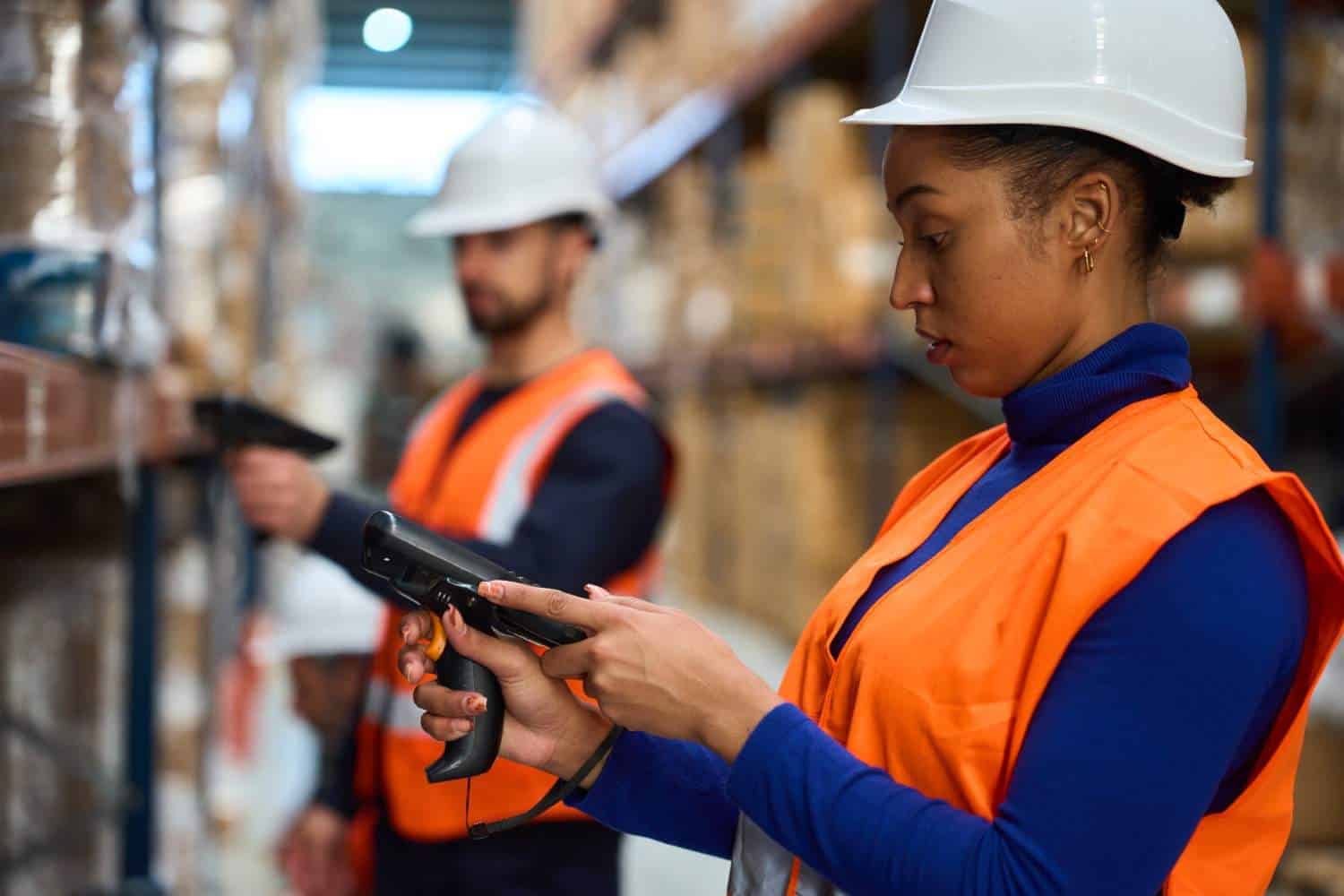
RFID tags are applied to the finished vehicles at the end of the production process, and fixed RFID readers are placed at the entrance and exit points of each zone. Personnel responsible for moving finished vehicles to holding areas are equipped with GPS-enabled handheld readers.
As vehicles move into or out of a zone, the fixed RFID readers report the movement to the fixed asset software enabled vehicle tracking system. As vehicles are parked within a zone, the personnel scan the RFID tag with the handheld, capturing both the RFID tag ID and the GPS location, which provides the vehicle tracking system with the exact location of the vehicle within the zone. Any vehicle can be located in mere seconds using the software.
The vehicle tracking software application is a web-based application accessible by a browser running on any PC, laptop, or tablet. In the case of outdoor vehicle tracking, the application displays a Google Earth-like image of the area to be tracked. The image is created by performing a Geo Survey of the area, collecting GPS coordinates of the entire perimeter, and loading them into the application.
In the case of indoor vehicle tracking, the system displays a blueprint of the facility in which vehicles are housed. In both indoor and outdoor applications, vehicles are displayed on the map where they were last seen by either a fixed RFID antenna or a handheld RFID reader.
Real-World RFID Vehicle Tracking Workflow in Manufacturing Operations
While the technical side of RFID tracking is important, what sticks with manufacturers is how it behaves in real, everyday use. Vehicle production environments are fast-paced, really coordinated, and they often involve thousands of moving assets at the same time. Without a structured tracking approach, even a minor visibility gap can start to snowball—causing delays, vehicles that end up misplaced, or inefficiencies that grow fast across the whole line.
This is where RFID-based vehicle tracking starts to matter a lot more. It gives structure, pushes automation, and adds real-time know-how into a process that otherwise turns into something very manual and kinda error-prone.
1. Vehicle Identification at Production Completion
The tracking process starts right after a vehicle is done with final assembly, literally as soon as that last step is complete. At that point, a passive UHF RFID tag is fastened to the vehicle, no fuss. That tag holds a single, unique identifier that is tied to the vehicle’s digital file, including things like manufacturing details, configuration info, and its intended destination.
In contrast to typical barcode labels, RFID tags really do not need line-of-sight scanning. So, the vehicles can still be tracked even if they are bunched up tightly together or sitting in those bigger production yards for a while.
After the tag is put on, the vehicle is, in effect, traceable through every operational zone at that point.
2. Zone-Based Movement Tracking Across the Plant
Most vehicle manufacturing facilities are divided into structured zones such as:
- assembly areas
- quality inspection zones
- staging yards
- shipping docks
- test tracks
Fixed RFID readers are installed at the entry and exit points of each of these zones. Every time a vehicle passes through a checkpoint, the system automatically records its movement.
This creates a continuous digital trail that shows:
- when the vehicle entered a zone
- when it exited
- how long did it remain in each stage
This eliminates the need for manual logs or spreadsheet-based tracking systems, which are often outdated by the time they are updated.
In large-scale operations, this zone-level visibility becomes essential for maintaining production flow and preventing bottlenecks.
3. Outdoor Yard Visibility and Large-Scale Inventory Control
One of the biggest challenges in making vehicles is dealing with outdoor storage yards, you know, those places where cars just sit for a while. These areas can hold hundreds, or even thousands of vehicles in one go, and they’re usually set up in tight spaces, with layouts that keep shifting.
Without RFID, trying to find a particular vehicle in that kind of environment can turn into a whole ordeal, like hours and hours.
With RFID-enabled tracking, though, the search actually becomes way quicker and more accurate, too.
Each time a vehicle is moved or scanned, its GPS-linked location is updated in the system. Handheld RFID readers used by yard personnel capture both:
- the RFID tag ID
- the exact GPS coordinates
This allows the system to display a “last known location” for every vehicle in the yard.
Instead of physically searching row by row, operators can simply look up the vehicle in the system and be guided directly to its approximate location.
4. Real-Time Coordination Between Teams

In many manufacturing environments, multiple teams are responsible for different stages of vehicle handling:
- production teams
- logistics teams
- quality control teams
- dispatch teams
Without a centralized tracking system, communication between these groups can become fragmented.
RFID solves this by creating a shared, real-time data environment.
For example:
- If a vehicle is marked ready for dispatch, logistics teams can immediately see it in the system
- If a vehicle is held for inspection, production teams are notified automatically
- If a unit is moved unexpectedly, the system updates instantly
This reduces dependency on manual communication and ensures everyone is working with the same accurate information.
5. Supporting R&D and Prototype Vehicle Tracking
Vehicle tracking is not limited to finished goods. Development and prototype vehicles also require strict monitoring, especially during testing phases.
These vehicles often move between:
- test tracks
- engineering labs
- validation zones
- external testing locations
Because prototypes are high-value and sensitive assets, losing track of them can cause major delays in development timelines.
RFID tracking allows manufacturers to:
- monitor test vehicle movement history
- ensure controlled access to restricted zones
- track usage patterns during testing phases
- maintain accountability for each prototype unit
This level of control helps R&D teams focus on development rather than logistics issues.
6. Reducing Search Time and Operational Delays
One of the most overlooked inefficiencies in vehicle manufacturing is search time.
Without RFID:
- employees may spend 20–60 minutes locating a single vehicle
- dispatch schedules may be delayed
- yard congestion increases
- productivity drops across teams
With RFID:
- vehicle location can be identified in seconds
- movement paths are clearly visible
- teams can coordinate faster
- delays are significantly reduced
Over time, these small improvements lead to major operational gains.
7. Improving Logistics and Dealer Delivery Speed
Once vehicles are ready for shipment, timing becomes critical. Dealers expect accurate delivery schedules, and delays can impact customer satisfaction and business relationships.
RFID tracking improves this by:
- ensuring vehicles are correctly staged before transport
- confirming dispatch readiness in real time
- reducing errors in loading and shipment selection
- improving coordination with transport providers
As a result, the entire outbound logistics process becomes smoother and more predictable.
8. Enhancing Accountability and Reducing Errors
Every movement recorded by the RFID system creates a traceable history. This includes:
- who moved the vehicle
- when it was moved
- where it was located
- how long did it stay in each zone
This level of transparency improves accountability across teams.
It also reduces common errors such as:
- misplaced vehicles
- incorrect dispatch selections
- duplicate handling
- untracked yard movement
Over time, this builds a more reliable and controlled operational environment.
9. Scaling for Large Manufacturing Networks
As manufacturers grow, tracking complexity increases. Multiple plants, yards, and distribution centers can make visibility difficult to maintain.
RFID systems scale easily because:
- tags are inexpensive and reusable
- readers can be added to new zones
- software centralizes all tracking data
- GPS integration supports multi-location visibility
This makes RFID suitable not only for single facilities but also for global manufacturing networks.
Other Use Cases
Vehicle tracking software has many applications aside from this specific kind automobile tracking. Transportation and logistics companies utilize it to track and find specific tractors and trailers. Material handling equipment manufacturers will find it valuable for end-of-production logistics when they move finished goods from the plant to a dealer or end user.
Ultimately, an RFID vehicle tracking application delivers essential flexibility and scalability for any company that needs to quickly and efficiently track and locate a specific vehicle, or type of vehicle, over a large geographic area or among a dense population of vehicles.
For more information on how your manufacturing business can use passive RFID to simplify vehicle traceability, contact us! You can also download our ebook “Are You Realizing the Full Benefits of RFID?”
Also read – Protect Your Assets While Still Meeting Lean Manufacturing Goals

A Horizons Talent Alumnus and Microsoft Certified Systems Engineer (MCSE), the author brings a proven track record of success in senior shared-services leadership roles within large, complex multinational organizations, particularly in the manufacturing sector.
With deep experience at Senior Manager level, they have led strategic customer relationships by understanding core business imperatives, shaping service and solution propositions, and delivering measurable business outcomes.