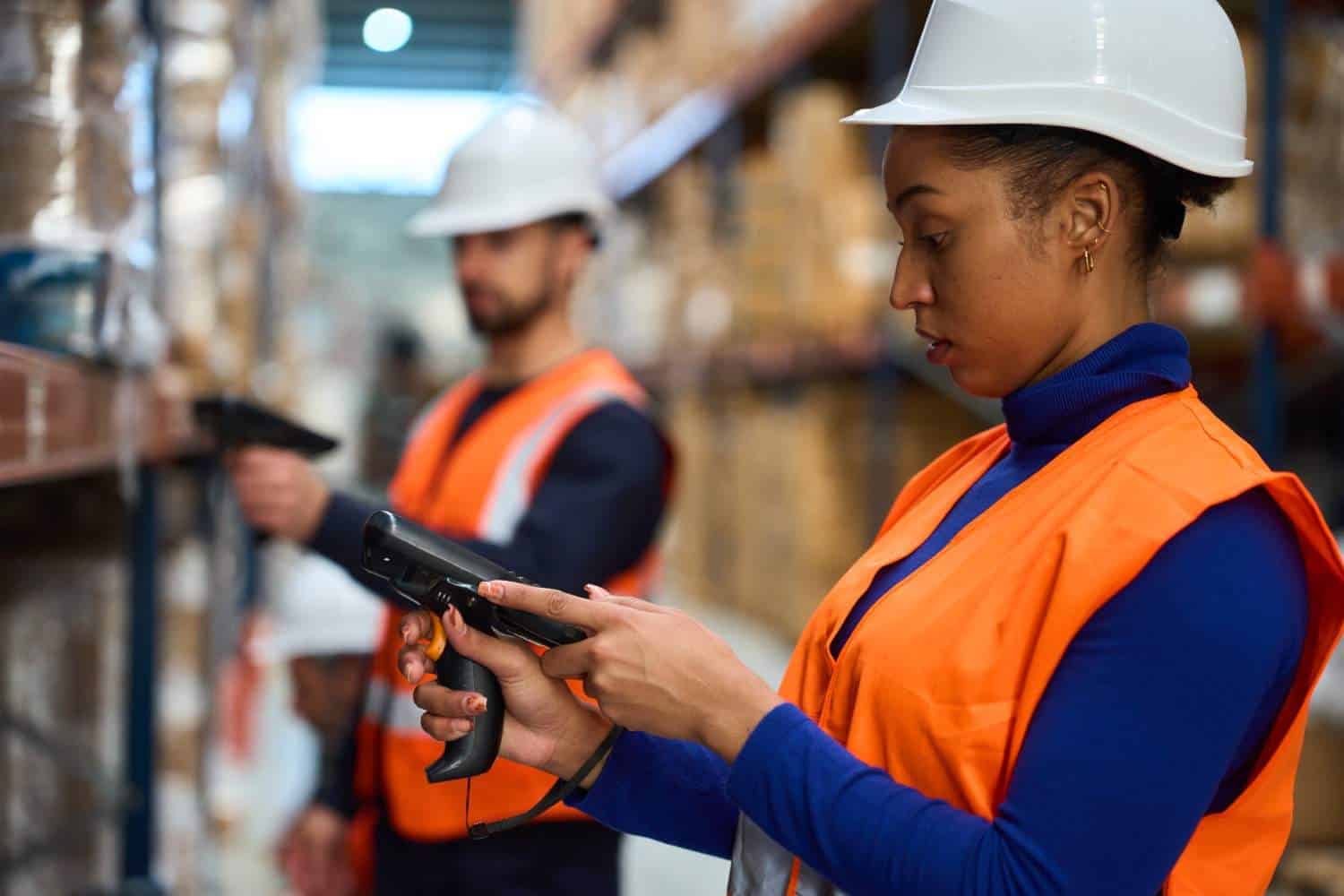
The workplace is on the move. Literally. In fact, the International Data Corporation (IDC) estimates that the population of mobile workers will grow to 1.3 billion, or 37.2% of the total global workforce by 2015. With such a rapid evolution on the horizon, it’s become increasingly important to equip these workers with the right mobility tools—such as mobile device management solutions—so that they are just as productive in the field as they would be at a desk.
Organizations that embrace mobility and other connective technologies will have a competitive edge for the following reasons:
• Cycle times are reduced because warehouse processes are streamlined
• Cost of labor is significantly decreased because productivity is increased
• Accurate order fulfillment, resulting in improved customer satisfaction
• The cost of sales attributed to movement through the warehouse is reduced
Not only will you gain efficiency in each separate process of your warehouse enterprise, you can realize business benefits throughout the scope of your operations as information is more effectively shared. Here’s a breakdown of how empowering a mobile workforce within your warehouse can build the foundation for enterprise-wide efficiency:

The yard: Warehouse mobility enables you to know the location of shipments in the yard through your warehouse management system (WMS). This stretches beyond your four walls; Visibility is greatly enhanced in trailers, containers and other materials in the yard. Even if items are moved, they are then easily tracked.
Not to mention, mobility creates a tight integration between your yard and warehouse workers. The wms management system can create a detailed schedule and deliver it to your workers’ mobile devices. Those workers can then be directed to the exact location of the trailer scheduled for conveyance. Workers will also have a greater awareness of shipment scheduling, so they can be ready on the dock at the exact time it will arrive.
Shipping:
Mobile solutions offer a final cross-check to ensure order accuracy, from having the correct address on the package to making sure it makes it on the right delivery truck.
Dispatch:
When dispatch can access real-time information via mobile devices, the following can occur:
• Load plans can be made well in advance, accounting for all shipments that will ship in the morning.
• Effective utilization of delivery vehicles and drivers, optimizing load aggregation.
• Trucks will be more fully loaded and delivery routes optimized.
Route Accounting
When extensive business data is available in real time to drivers, more benefits incur. Perhaps your drivers just need proof of delivery or more sophisticated route accounting and direct store delivery functions. With mobility functions, electronic signatures can be easily captured and an instant proof of delivery noted in your business systems, which then expedites billing — and payment.
Sales
Mobility in your warehouse can even empower your sales force to check inventory, get pricing and place orders, right from a customer’s location. Real-time access to inventory data can mean big wins for sales in three primary ways:
Increased Productivity: Paper forms are replaced by more efficient and data-rich computer-based forms
More sales: Technology lessens the load of paperwork, and sales reps can spend more on the phone and making sales.
Improved Customer service: When a customer calls about order status, that information is available in real-time and at the salesperson’s fingertips. When this information is readily available, customer satisfaction levels increase.
Field Service
When you adopt mobility, you’ll realize integrated warehouse and field service functions, which in turn raises efficiency and customer service levels. With mobile computers in hand, field personnel can have access to real-time information for everything from warranty information on items, repair history to accurately diagnose problems on the first visit — to field contract expiration dates so they can potentially upsell or cross-sell related services — creating potential revenue opportunities for your business.
The warehouse is a vital part of your company’s operations. If it is poorly managed, every aspect of your business is negatively impacted. Mobility is a trend that can’t be ignored. If you deploy the right mobile technology and related software systems that fit your unique business needs, your operations will realize a new level of visibility into your enterprise. That means better, more informed business decisions and potentially a boost to your bottom line.
Creating a More Agile Warehouse with Mobile Technology
Warehouses are under more pressure than they used to be. Customers want faster deliveries. Order volumes keep climbing. Labor is harder to find and harder to keep. And the margin for error keeps getting thinner.
Most warehouse operations were not built for this pace. They were built around paper pick lists, fixed terminals, and manual data entry, systems that made sense when things moved more slowly. Today, those same systems create friction at every step, and that friction adds up fast.
Mobile technology is one of the more practical ways warehouses are adapting. Not as a flashy upgrade, but as a direct fix for the daily bottlenecks that slow teams down and create errors that nobody catches until something has already gone wrong.
Eliminating Operational Bottlenecks
A lot of warehouse time gets eaten up by information gaps. A worker walks to a terminal to check inventory. A supervisor hunts down a paper list to assign the next task. An order status does not get updated until someone remembers to enter it.
None of those delays feels dramatic in isolation. But they compound across hundreds of transactions a day, and the cumulative effect on throughput is significant.
Mobile devices close those gaps by putting current information directly where the work is happening:
- Inventory levels are visible instantly without walking to a terminal
- Task assignments are pushed to devices the moment they are ready
- Order statuses updated in real time as work gets done
- Product locations confirmed on the spot without back-and-forth
- Shipment information is available on demand from anywhere in the facility
When workers stop waiting for information, the whole floor moves faster.
Improving Inventory Accuracy

Inventory records that do not match physical reality create problems that ripple through the entire operation. A stockout that was not a stockout. An order is picked for a product that turns out to be somewhere else. A replenishment that triggers too late because the system showed more than was actually there.
Mobile scanning fixes the root cause. Inventory gets updated the moment it moves, when a product comes in, when it gets picked, or when it gets transferred between locations. The system reflects what is actually happening rather than what someone recorded at the end of a shift.
The results tend to be consistent:
- Fewer discrepancies between physical stock and system records
- Faster cycle counts that do not require halting operations
- More reliable replenishment based on accurate real-time data
- Better order fulfillment because the inventory picture is trustworthy
- Higher service levels because stockouts get caught before they affect customers
Inventory accuracy is not just an internal metric. It directly affects whether customers get what they ordered and when.
Enhancing Workforce Productivity
A surprising amount of warehouse labor goes toward things that are not actually moving products, searching for items, waiting on instructions, fixing errors from earlier in the shift, and walking back to check something that should have been on a device.
Mobile technology cuts into all of that. Workers get step-by-step guidance on their devices. They can confirm locations, check quantities, and report issues without leaving their zone. The work itself becomes simpler and faster because the information is already there.
In practical terms:
- Picking speeds up when workers are not second-guessing locations
- Travel time inside the facility drops with better-directed workflows
- Errors decrease because confirmation happens at the point of action
- Issues get resolved faster without waiting to track down a supervisor
- Higher volumes become manageable without proportional increases in headcount
Workers who have the right tools tend to get more done and make fewer mistakes doing it.
Supporting Better Collaboration
Warehouses are not one department. Receiving, inventory, shipping, and supervisors all have to stay aligned for the product to move through efficiently. When communication breaks down between those groups, things stall.
Mobile technology keeps everyone working from the same current picture. A receiving team scans incoming products, and it immediately shows up for inventory. A shipment status change occurs, and the relevant team knows right away. A problem on the floor gets flagged without anyone having to leave their station to report it.
That kind of real-time coordination leads to:
- Fewer communication delays between teams
- More accurate scheduling because everyone has current information
- Better visibility across the whole facility at once
- Faster decisions when something unexpected comes up
- Less disruption when plans change mid-shift
When teams are working from the same data at the same time, handoffs go more smoothly, and surprises become less common.
Preparing for Future Growth
Growth makes warehouse operations more complex, more SKUs, more orders, more locations, more people. Processes that hold up fine at current volume often start breaking down when things scale.
Mobile infrastructure scales with the operation. New facilities can be brought online with the same workflows. New workers can be onboarded onto familiar processes. Visibility stays consistent across the network regardless of how many locations get added.
That foundation matters when growth happens quickly, and there is no time to rebuild systems from scratch.
Pulling It Together
A warehouse that runs well is built on three things: accurate information, clean workflows, and workers who have what they need to do their jobs. Mobile technology directly supports all three.
The operational improvements are real: faster throughput, better inventory accuracy, stronger team coordination, and the ability to handle more volume without proportional cost increases. For warehouses trying to keep up with rising customer expectations while holding the line on costs, that combination is hard to argue with.

A Horizons Talent Alumnus and Microsoft Certified Systems Engineer (MCSE), the author brings a proven track record of success in senior shared-services leadership roles within large, complex multinational organizations, particularly in the manufacturing sector.
With deep experience at Senior Manager level, they have led strategic customer relationships by understanding core business imperatives, shaping service and solution propositions, and delivering measurable business outcomes.