Partner Blog
by: Barry J. Ewell / Honeywell
Since the launch of the Mobility Edge platform for mobile computers, Honeywell continues to future-proof its devices. As part of our ongoing leadership with Android and Mobility Edge, Honeywell is pleased to announce that the Mobility Edge Android version GUARANTEE has been extended to include Android 12 and continues to being committed to compatibility through Android 13, subject to feasibility.
What is the difference between Guarantee vs. Commitment to Android 12?
When Honeywell states that the Mobility Edge platform now guarantees Android 12, all current and future mobile devices on the Mobility Edge platform will be able to receive the Android 12 operating system.
When selecting mobile computer platforms, be sure to understand the difference between “commit” or “specified” and a “guarantee”. Commitments and specifications can be subject to change. Our guarantee provides the certainty companies need in order to ensure they receive the ROI they expect, and are receiving the best available security well into the future.
As of this writing, Honeywell is the only mobile computer vendor that guarantees compatibility through Android 12 and commits through Android 13.
How is Honeywell able to Guarantee Android 12 for the Mobility Edge platform?
It is important to remember that Honeywell’s Mobility Edge is a unified hardware and software platform for all form factors. The platform provides for rapid deployments, enhanced performance, and adaptability to changing needs. With Mobility Edge, a one-time investment in setup, deployment, and provisioning is reusable across all device types.
Every Mobility Edge device receives each Android OS version, without gaps starting with Android version that device is launched with, for as long as we can guarantee, currently through Android 12. Honeywell and Google recommend their customers maintain the latest OS version on all devices. Security best practices include using devices capable of receiving OS version updates for as long as possible.
When Honeywell completes the engineering effort to create and validate a current Android OS image for one device, this means we have done it for virtually all of the Mobility Edge platform family of devices. Mobility Edge makes it easy for our customers, who often have more than one type of device in their mobile device estate, to upgrade to the next Android version.
Honeywell can make this commitment because of the Mobility Edge and SOM platform approach. Honeywell is the leader in utilizing a SOM approach in ruggedized mobile computers.
SOM has enabled Honeywell to have a single software and hardware set across all devices. Without this, software maintenance and upgrades are more expensive. (Compare the price of Honeywell Android maintenance to others.)
All Honeywell Mobility Edge devices have the Honeywell SOM platform and a single firmware image. Honeywell, through its Mobility Edge platform, has a history of unbroken OS version continuity from device launch, guarantees each OS version through Android 12, and does so using a single software image.
What is Mobility Edge platform and SOM?
Mobility Edge offers an integrated, repeatable, scalable approach to workflow automation based on a common hardware and software platform. Designed for Android, it delivers a unified platform on which all software solutions are based. Businesses can develop and deploy faster while reducing development costs.
The Mobility Edge unified platform is composed of:
• Common Hardware (System On Module, or SOM), which includes the CPU, memory, WWAN (in selected devices), WLAN, Bluetooth, and near-field communication (NFC).
• Common Operating System Image with support for multiple generations of Android, from Android O through Android 12.
• Common Software Ecosystem that includes not just Honeywell software but also Honeywell-approved ISVs (independent software vendors).
Together these common elements minimize your company’s cost, effort, and risk. They accelerate your time-to-value so you can start deploying devices into the hands of your mobile workers much faster. And they maximize your ROI by extending the lifecycle of your devices. And provide the best available security, latest features, and technology.
What is the Honeywell track record for guaranteeing Android OS on Mobility Edge platform devices?
Since launching the Mobility Edge platform, Honeywell’s Android version guarantee and commitment has been demonstrated through unbroken continuity of each Android version availability staring with the Android version on which the device launched. Let’s look at examples of devices used in retail and warehouse applications.
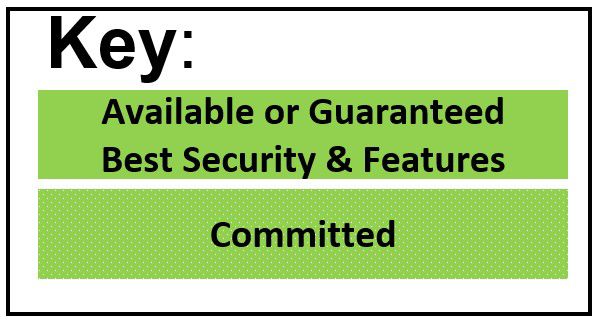
Honeywell Mobility Edge Retail Example. The Honeywell CT40 family of mobile computers, which makes up the first four lines in the graphic below, was first launched on Android 7/N. A few years later, Honeywell introduced a newer version called the CT40XP on Android 9/P.
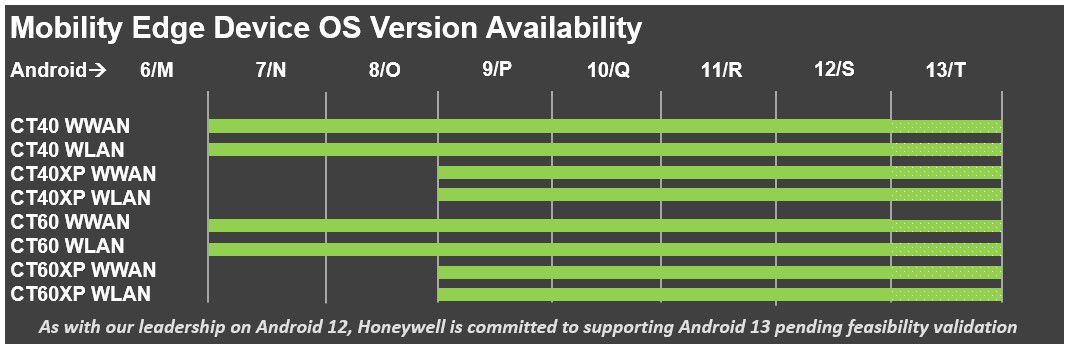
Even though Honeywell introduced new hardware, we continue to provide each Android update and major version without gaps for the older CT40, which are still available for purchase. As a Mobility Edge device, CT40 will potentially be available through 7 Android versions (7/N through 13/T) with NO gaps and is guaranteed through at least Android 12. The same forward compatibility is valid for the CT60 and newer CT60XP.
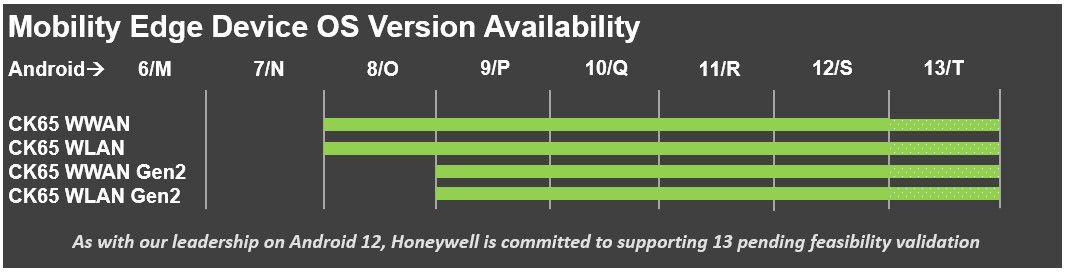
Honeywell Mobility Edge Warehouse Example. The Honeywell CK65 family of mobile computers was first launched on Android 8/O. Even though Honeywell introduced new hardware, we continue to provide each Android version and updates for the older CK65, which is still available for purchase. As a Mobility Edge device, CK65 will potentially be available through 7 Android Versions (7/N through 13/T) with NO gaps and is guaranteed through at least Android 12.
Why Long-Term Android Support Matters for Enterprise Mobility
Enterprise mobile devices have come a long way from simple scanning tools. Today, they’re running core workflows across warehouses, retail floors, manufacturing facilities, transportation operations, and field service teams. When one goes down or falls out of support, it’s not an inconvenience; it’s an operational problem.
That’s made device lifespan, security, and long-term software support a much bigger part of the buying conversation than it used to be.
One of the more persistent headaches for IT and operations teams is managing OS upgrades over a device’s life. Hardware replacement cycles, inconsistent software support, and security gaps all add up, in cost, in disruption, and in time nobody has to spare. It’s a big part of why long-term Android support has moved up the priority list when organizations are evaluating enterprise mobile computers.
Honeywell’s Mobility Edge platform was built specifically to address that problem.
The Importance of OS Longevity in Enterprise Devices
Consumer phones get replaced every couple of years. Enterprise mobile computers don’t work that way, or at least, they shouldn’t have to.
Rugged devices in warehouses, logistics operations, retail environments, and manufacturing facilities are expected to hold up across multiple shifts, demanding conditions, and years of heavy use. Replacing them on a consumer-style refresh cycle isn’t realistic for most organizations, and it’s not what the investment was designed for.
When a device loses OS support too early, the consequences tend to pile up fast:
- Security vulnerabilities with no patch coming
- Applications that stop being compatible
- Costly hardware refreshes that weren’t budgeted for
- Higher IT management overhead
- Workflow disruptions during transitions
- Shrinking application support over time
Long-term Android support keeps those problems from surfacing prematurely and protects the technology investment over the full intended lifespan of the device.
A More Stable Mobility Strategy
One of the quieter advantages of a platform like Mobility Edge is what it does for consistency across the fleet.
Rather than managing a mix of device architectures and software variations that have accumulated over several generations of hardware, organizations can standardize around a single unified platform. That predictability makes a real difference, for deployment, for support, for training, and for upgrades that don’t turn into multi-month projects.
For IT teams specifically, that plays out as:
- Simpler device management across the board
- Faster software deployment without compatibility guesswork
- Reduced testing requirements when something changes
- Cleaner OS upgrade paths
- Better application compatibility across device generations
Operations teams benefit too, because the workflows employees rely on stay consistent as devices get refreshed, no relearning, no retraining from scratch.
For organizations running large fleets of rugged devices across warehouses, stores, transportation networks, or field operations, that kind of stability is worth a lot.
Supporting Security and Compliance
Security in enterprise mobility isn’t a set-it-and-forget-it situation.
Threats evolve. Compliance requirements shift. And devices that have stopped receiving OS updates become a liability, vulnerable to exploits, potentially out of step with regulatory requirements, and increasingly difficult to justify from a risk management standpoint.
Extended Android support keeps devices in a defensible security posture for longer. That matters across virtually every environment where enterprise mobile computers are deployed:
- Inventory management
- Healthcare workflows
- Transportation operations
- Asset tracking
- Mobile workforce management
These aren’t environments where you can afford devices running outdated software for months while waiting on a hardware refresh cycle. Consistent OS updates keep devices compatible with enterprise applications and aligned with the security standards the business is held to.
Reducing Total Cost of Ownership
Replacing enterprise devices before their time is expensive, and the hardware cost is only part of it.
Every device refresh comes with provisioning work, software configuration, employee retraining, downtime during the transition, IT labor, and integration testing. None of that is cheap, and none of it adds operational value. It’s pure overhead.
Platforms with longer OS support stretch the useful life of existing hardware. Instead of replacing devices because the software ran out of road, organizations keep using what they have, while still getting updated Android functionality and current security patches.
Over a fleet of any meaningful size, that adds up to a real difference in total cost of ownership.
Designed for Scalability
Most enterprise mobility deployments don’t start at full scale. They begin with one department, one workflow, one facility, and then grow from there.
A unified platform makes that expansion less painful. Mobility Edge supports a range of device types across the same architecture:
- Handheld mobile computers
- Warehouse scanners
- Vehicle-mounted computers
- Rugged tablets
- Retail mobility devices
Running the same platform across multiple form factors cuts complexity for IT and keeps the experience consistent for employees. People work with systems they already know. IT maintains centralized control across the whole device ecosystem without managing a patchwork of different platforms.
Improving Enterprise Mobility Management
Managing a large device fleet without standardization is genuinely difficult. Different hardware generations, different software versions, different configuration states, it creates a management burden that grows faster than the fleet does.
A unified hardware and software approach takes a lot of that complexity off the table. Consistency across devices means:
- Faster provisioning when new devices are deployed
- Simpler application rollouts
- More reliable remote management
- Cleaner software update processes
- Easier troubleshooting when something goes wrong
- Smoother onboarding for new employees
When that’s paired with enterprise mobility management and MDM tools, the result is an IT team that’s actually in control of its mobile infrastructure rather than constantly chasing it.
Supporting Future Operational Growth
Technology investments that create limitations down the road aren’t really investments; they’re deferrals.
As organizations build out automation, real-time tracking, IoT connectivity, and cloud-based workflows, the mobile devices running those operations need to keep up. That means staying compatible with new applications, new integrations, and new operational demands that didn’t exist when the devices were originally deployed.
Long-term Android compatibility gives organizations a reasonable degree of confidence that the devices they’re buying today won’t become a bottleneck when the operation evolves. In industries where uptime and scalability directly affect productivity and customer satisfaction, that flexibility isn’t a nice-to-have; it’s a requirement.
Conclusion
Honeywell Mobility Edge provides unmatched Android version support providing the best available security, features, and lifecycle duration of any ruggedized mobile computer offered from major brands. Honeywell is deeply committed to the longevity and quality of the Mobility Edge platform. The following products are built on the Mobility Edge platform: Honeywell CT40, CT40XP, CT60, CT60XP, CN80, CN80G, CK65, RT10A, and Thor VM1A, and VM3A.
Contact a Lowry Solutions Expert today! Call 1-888-881-2477
Android is a trademark of Google LLC.
Bluetooth is a trademark of Bluetooth SIG, Inc.
###

A Horizons Talent Alumnus and Microsoft Certified Systems Engineer (MCSE), the author brings a proven track record of success in senior shared-services leadership roles within large, complex multinational organizations, particularly in the manufacturing sector.
With deep experience at Senior Manager level, they have led strategic customer relationships by understanding core business imperatives, shaping service and solution propositions, and delivering measurable business outcomes.